


It isn’t an understatement to say that Canada is in a moment of tremendous economic and cultural change, with Canadian people embracing nationalism to a degree not seen in a generation. We can see the appeal of Canadiana being leveraged by savvy communicators in advertising, on store shelves, and political speeches, and it doesn’t seem to be fading.
The latest Edelman Trust Barometer, which measures public trust in institutions (including government, media, NGOs, and business), highlights an important dynamic in Canada that gives us insight into what is driving Canadian attitudes and behaviour, and implications for organizations operating here.
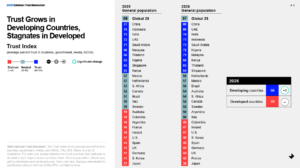
Overall trust levels in Canada are modest by global standards. Canada sits near the middle of the global Trust Index and well below many developing markets where trust continues to grow.
Yet one finding stands out.
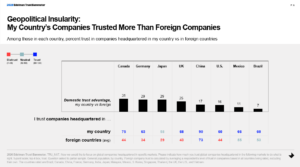
Canadians report far greater trust in companies headquartered in Canada than those headquartered abroad. The gap is striking: a Trust Index score of 75 for Canadian companies compared with 44 for foreign-headquartered companies, a 31-point domestic advantage, the largest measured globally.
Many companies have already begun emphasizing their Canadian identity more deliberately, highlighting domestic investment, Canadian jobs, and contributions to local communities. This instinct is also showing up in consumer behaviour, as Canadians increasingly look for domestic products and reduce spending in the United States amid tariffs and sovereignty tensions. It is not unreasonable to suggest that reinforcing those connections can strengthen that trust advantage.
Provincial governments appear to be reading the same signals, and policy has begun to shift in that direction as well. Ontario’s Protect Ontario agenda emphasizes defending provincial economic interests while introducing measures that prioritize local suppliers and industries. In Quebec and Alberta, governments continue to assert stronger provincial autonomy in economic and regulatory policy, reflecting a broader push to protect regional interests and economic resilience. Across the country, provincial messaging and policy increasingly centre on strengthening local industries, workers, and economic capacity.
At the national level, Prime Minister Mark Carney, speaking at Davos, suggested Canada will need to act more independently as a country in response to shifting U.S. policy and global economic uncertainty. Acting more independently, he acknowledged, will come with real costs.
The open question is where this instinct ultimately leads.
Does a renewed focus on Canadian institutions strengthen a shared sense of national purpose? Or does protecting what is closest to home gradually evolve into something more individualistic, where provinces, sectors, communities, and Canadians increasingly prioritize their own interests? And if these shifts continue, how might it shape the choices Canadians make at the ballot box?
It may be too early to draw firm conclusions. The political and economic context is shifting quickly, and public sentiment often shifts with it. Yet the signals emerging across public opinion, policy, and consumer behaviour suggest this focus on Canadian institutions and economic self-reliance is unlikely to fade any time soon. For the time being, organizations and leaders must stay attuned to these signals and remain ready to adapt as the moment continues to evolve.