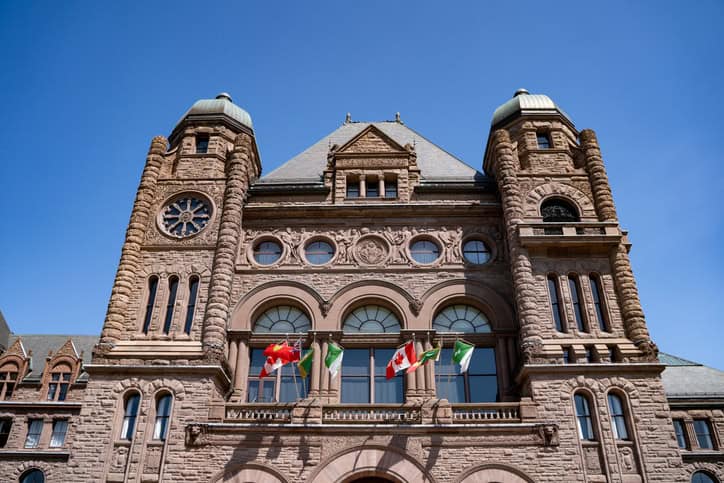
From housing and transportation to school board governance, Queen’s Park moved forward on major reforms while navigating contentious public debates.
Ontario’s spring legislative session ends with Ford focused on affordability, infrastructure and political durability
Ontario’s spring legislative session is ending with Premier Doug Ford’s government returning to a familiar message: economic growth, infrastructure delivery and stability amid uncertainty. The session opened with a strong focus on affordability, as high living costs, housing pressures and broader economic volatility dominated public debate.
That message was tested when the government faced backlash over its short-lived purchase of a $28.9-million private jet. The episode quickly became the session’s defining political controversy, raising questions about judgment and consistency with the government’s affordability narrative.
Even so, the government spent the spring advancing a broad agenda centred on housing, infrastructure and public safety, while opposition parties continued trying to sharpen their profiles, rebuild support and take advantage of any political missteps by the PC government.
Most significant legislative issue: Housing and infrastructure acceleration
If one issue defined the session, it was the government’s effort to accelerate housing and infrastructure delivery. Bill 98, the Building Homes and Improving Transportation Infrastructure Act, was the centrepiece of that effort. It would streamline approvals, reduce red tape and better align infrastructure planning with housing growth. The push also included Bill 100, which would increase provincial oversight of municipal decisions and give regional leaders more tools to speed approvals. Together, the measures show a government intent on building faster and competing for investment during a period of economic uncertainty.
Biggest political story: The private jet controversy
Every session has a defining political flashpoint, and this spring it was the government’s brief purchase and rapid resale of a private jet. Although initially presented as a practical tool for government travel, the decision triggered immediate backlash given ongoing affordability pressures. The government reversed course within days, but the controversy lingered as questions about cost, transparency and decision-making broadened the political damage. For a government that has long emphasized economic management and relatability, the episode underscored the importance of optics and the need to respond quickly when public sentiment turns.
Most consequential legislation: Billy Bishop Airport expansion
Another major legislative fight was Bill 110, the Building Billy Bishop Airport Act. The bill would allow the province to take control of key City of Toronto lands and shape the airport’s future, opening the door to expansion. Supporters say that could boost capacity, connectivity and economic growth, while critics argue it weakens municipal authority and raises waterfront concerns. The debate captured the government’s broader approach: pursuing major infrastructure projects even when controversy is likely.
Most consequential progress made: Expanding Scopes of Practice for regulated health professions
While the government has long trickled out new measures that allowed nurse practitioners and pharmacists to do more, this past month saw the largest scope of practice announcement in a generation. This involved directing Ontario’s regulatory health colleges for optometrists, physiotherapists, chiropractors, dental hygienists, denturists, audiologists and speech-language pathologists to begin work on the necessary enabling measures that would allow patients better access to diagnostic imaging tools like x-rays and diagnostic ultrasounds, making good on a 2025 election promise.
School Board governance reforms spark widespread public debate
This spring Education Minister Paul Calandra was hard at work passing the Putting Student Achievement First Act, introducing major changes to school board governance. The legislation increased provincial oversight, capped trustee numbers, and limited trustee expenses. It also created new executive leadership roles focused on financial management and student achievement. The government said the reforms would improve accountability and student outcomes, while critics argued they reduce local democratic control.
Most consequential change: Resignation of political heavy-weight Caroline Mulroney
The end of session also represents the last days of Caroline Mulroney’s time as part of the Ford government. Once a rival for the party’s leadership, Mulroney became an instrumental player in Premier Ford’s cabinet, spending time as Attorney General, Transportation Minister, Treasury Board President and Francophone Affairs Minister. With a long list of accomplishments in each portfolio, she will be a difficult Minister for Ford to replace. As the daughter of the late Canadian Prime Minister, Mulroney grew up in the political-eye and is a household name to many. She was a star candidate for the PCs and it is never good thing for a government to lose some of its top talent.
Overall political performance
Ford and the Progressive Conservatives maintained a disciplined message on growth, infrastructure and stability, helping preserve their advantage despite the private jet controversy. Opposition parties found some traction on affordability, health care and accountability, but remain too fragmented to present a strong province-wide alternative.
Story under the radar: Ontario’s economic positioning
Beyond the day-to-day controversies, the government also continued trying to position Ontario as a hub for manufacturing, energy and emerging industries. Those efforts drew less attention than affordability or scandal, but they could shape investment and growth well beyond this session. Housing remains one of the government’s biggest vulnerabilities. Despite policy changes, supply constraints and market conditions continue to limit progress. Health care poses a similar challenge, with staffing shortages and access concerns continuing to weigh on voters. Both issues are likely to remain long-term political tests.
The session ends, but the central question remains
As the Legislature rises, Ontario politics is still shaped by one central question: In a period defined by affordability pressure and economic uncertainty, who do voters trust to manage growth, stability and cost of living at once? For now, the Ford government still appears to hold that advantage. Whether it can maintain it will depend not only on policy outcomes, but on political judgment.
What does this mean for your business?
The government will be looking to make a hard pivot this summer away from a turbulent few months. We expect the government to double down on measures that found them earlier success: housing, infrastructure and protecting Ontario from US tariff fallout. While it may remain challenging to cut-through on issues unrelated to infrastructure or the economy, Ontario will be most interested in identifying partners that can help re-enforce its political brand as a government that is in office not for the perks but to deliver for the people.
Queens Park was scheduled to return sitting on September 14th but will remain in recess until October 27th.