
The Conservative Party of British Columbia has elected former federal cabinet minister Kerry-Lynne Findlay as its new leader. The competitive leadership race offered an unusually clear look at the debates shaping the future of the province’s Official Opposition.
“The Conservative Party of BC will stand together because we know that we can make a difference. We can fight back and we can deliver real change,” she told about 700 party members gathered in Vancouver.
Findlay, 71, is a veteran Conservative politician, lawyer, and former federal cabinet minister who served as MP for South Surrey–White Rock from 2019 to 2025, and previously as MP for Delta–Richmond East from 2011 to 2015.
Before entering federal politics under former Prime Minister Stephen Harper, she practised law with a focus on labour, employment, and mediation. During her time in Ottawa, Findlay served as Minister of National Revenue and briefly as Associate Minister of National Defence.
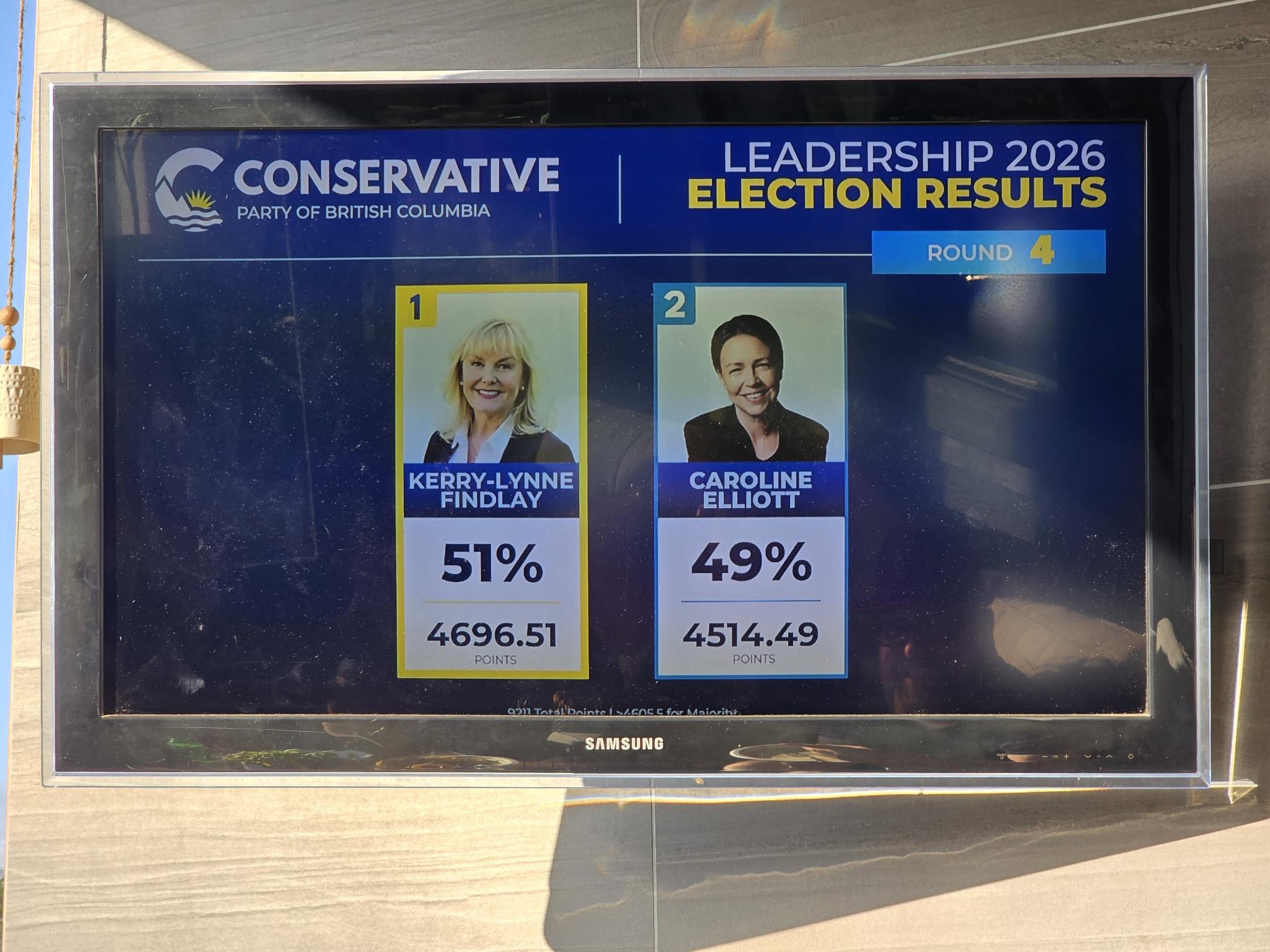
Findlay, or KLF as she is commonly referred to, defeated Caroline Elliott on the fourth and final ballot, securing 4,696.5 points to Elliott’s 4,514.5 under the party’s equal riding-weighted voting system. A total of 4,605.5 points were required for victory.
The result capped a contest that began with five candidates representing different experiences, priorities, and visions for the party. Findlay led on every ballot, beginning with 30.5 per cent support and ultimately securing 51 per cent on the final count.
The ballot-by-ballot results tell an important story. While Findlay never lost her lead, Elliott steadily consolidated support from eliminated candidates and finished only 182 points behind. The narrow margin reflects both Findlay’s success in building a grassroots movement and the strength of the coalition that formed behind Elliott.
For a party that has experienced extraordinary growth over the past three years, the leadership race demonstrated both unity of purpose and meaningful debate about the path forward.
More Agreement Than Division
Public commentary throughout the race often focused on differences between candidates. The reality was more nuanced.
All five candidates campaigned on a platform of economic growth, resource development, public safety, affordability, and greater government accountability. Every major candidate proposed repealing the Declaration on the Rights of Indigenous Peoples Act (DRIPA), reducing regulatory burdens, accelerating project approvals, and adopting a tougher approach to crime.
Where the candidates differed was in emphasis.
Yuri Fulmer centred his campaign on civil liberties and a proposed provincial Freedom Charter. Peter Milobar emphasized fiscal management and practical governance. Iain Black positioned himself as an experienced economic and business leader capable of preparing the party for government.
Findlay framed the contest as a fight to preserve the party’s conservative identity and prevent a return to the political approaches that defined the BC Liberal era.
Elliott focused heavily on indigenous reconciliation policy, and ending SOGI (Sexual Orientation and Gender Identity) in BC schools. However, she struggled to establish credibility with members that questioned her connections to former BC Liberal leader Kevin Falcon and the Ontario Conservatives operatives that ran her campaign. Members ultimately chose Findlay’s vision.
Her campaign consistently linked economic growth, resource development, property rights, public safety, and individual freedoms into a broader argument that British Columbia requires a significant change in direction after nearly a decade of NDP government. That message clearly resonated with party members.
What the Results Reveal
The final result provides several insights into the current state of the Conservative Party.
First, Findlay won because she portrayed herself as an authentic, unapologetic Conservative.
She emerged from the first ballot as the frontrunner and maintained her lead throughout. Even after Elliott received a larger share of the final ballot transfers following Iain Black’s elimination, Findlay’s early advantage proved decisive.
Second, the results suggest that the membership and caucus approached the leadership race from somewhat different perspectives.
Prior to voting, Findlay and Peter Milobar each secured the support of nine Conservative MLAs. Milobar was also the only sitting MLA in the race. Iain Black received endorsements from five MLAs, including former leader John Rustad. Caroline Elliott secured endorsements from three caucus members. Six caucus officers remained neutral, and four MLAs declined to make a public endorsement.
The endorsement map demonstrated that support within caucus was broadly distributed. The membership vote demonstrated that grassroots members ultimately made their own assessment of the party’s future direction.
Taken together, the results point to a party whose influence is no longer concentrated among elected officials or long-time organizers. Conservative members are increasingly shaping the direction of the movement themselves.
The Challenge Ahead
Findlay inherits a party that has grown rapidly and now occupies a very different position in British Columbia politics than it did only a few years ago.
The challenge facing the Conservatives today is fundamentally different from the challenge they faced under John Rustad.
Building a political movement and preparing to form a government require different skills, different structures, and different forms of discipline.
Findlay’s immediate task will be bringing together a caucus that contains former BC Liberals, long-time conservatives, municipal leaders, business advocates, social conservatives, libertarians, and rural populists.
The success of Findlay’s leadership will depend in part on how effectively those perspectives are incorporated into a common political project.
Several questions will shape that effort in the months ahead.
Will the party seek to rebuild relationships with independent MLAs who left caucus during the final months of Rustad’s leadership? And if she does, how will others in her caucus react?
How will Findlay structure her leadership team and shadow cabinet?
What role will caucus veterans such as Peter Milobar and Iain Black’s supporters play in the next phase of the party’s development?
And how will the party balance the priorities of its activist base with the broader coalition of voters that brought the Conservatives within striking distance of government in 2024?
Those questions matter because they will influence the party’s ability to expand support beyond its existing base while maintaining the enthusiasm that has fuelled its recent growth.
The work of uniting her colleagues begins Sunday with a full day caucus meeting.
Findlay was publicly endorsed by nine of 38 Conservative MLAs: Brent Chapman, Sheldon Clare, Sharon Hartwell, Steve Kooner, Anna Kindy, Heather Maahs, Macklin McCall, Lawrence Mok, David Williams plus two former Conservative MLAs, now sitting as independents, Tara Armstong and Jordan Kealy.
It is likely that several of these MLAs will be promoted to the caucus leadership team. Watch for Steve Kooner, Sheldon Clare and Heather Mahs to take on greater caucus responsibilities.
Findlay must also decide whether any of the six independent MLAs who left or were expelled from the BC Conservative caucus, likely beginning with Armstrong and Kealy, will be invited to return.
She will also need to secure a seat in the Legislature, potentially, as some have speculated, through the resignation of her husband, Brent Chapman, the current MLA for Surrey South.
Saturday night Chapman suggested if he did resign his seat, he would run in another riding in the next general election.
Key Policy Files to Watch
The leadership campaign also offered important clues about where Conservative pressure on the government is likely to intensify.
Throughout the campaign, candidates repeatedly linked economic growth to faster approvals, reduced regulatory burdens, expanded mining activity, energy development, and stronger protections for private property rights.
Indigenous relations are also likely to remain a defining issue.
Every major candidate supported repealing DRIPA, but Findlay made the issue a central feature of her campaign. How the party advances that position will be closely watched by Indigenous governments, industry proponents, municipalities, and investors.
Public safety is another area where Conservatives appear likely to maintain pressure on the government. Every candidate proposed stronger responses to repeat offenders, organized crime, and the fentanyl crisis, reflecting concerns that continue to resonate across many parts of the province.
At the same time, Findlay’s campaign placed significant emphasis on parental rights, education policy, and freedom of expression. Those issues generated strong support among many party members and will likely remain part of the party’s broader political narrative.
Looking Ahead
Findlay’s victory closes one chapter in the Conservative Party’s development and opens another.
The leadership race demonstrated that Conservative members remain deeply committed to the principles and priorities that drove the party’s growth over the past three years. It also revealed a party that is increasingly confident, increasingly organized, and increasingly focused on the prospect of forming government.
The months ahead will test whether that momentum can be sustained under new leadership.
For clients, the most important takeaway is that the Conservatives emerge from this race as a serious and consequential political force. The questions facing the party now center on governance, coalition-building, and readiness for power.
How Kerry-Lynne Findlay answers those questions will shape British Columbia’s political landscape well beyond the next legislative session.