

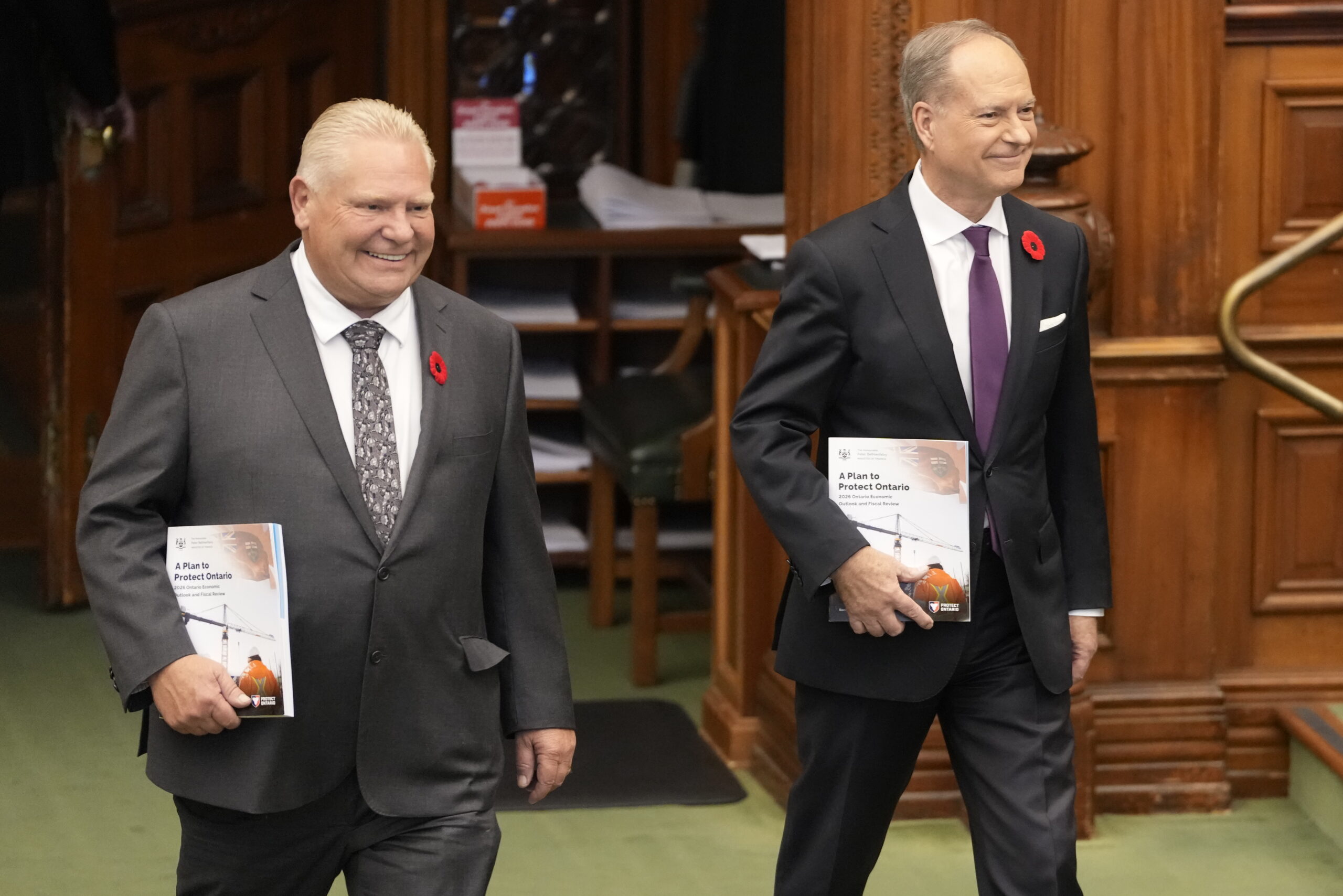
With the fall legislative session now underway, the Ford Government tabled its 2026 Ontario Economic Outlook and Fiscal Review (Fall Economic Statement, or FES) on Thursday, offering a detailed glimpse of its Protect Ontario agenda and the impact of cross border trade issues on the province’s finances.
In his remarks before the Legislature, Finance Minister Peter Bethlenfalvy emphasized a focused and disciplined approach to spending while continuing to shield Ontario workers and businesses from the lingering effects of U.S. tariffs. Beyond previously announced tariff protection measures and tax incentives, today’s FES contains few additional signature initiatives or spending announcements. Despite higher forecast revenues and the government’s emphasis on restraint, Ontario’s projected deficit rises to $16.9 billion, up $3.1 billion from the 2026 Budget forecast.
As he has done in the past, Minister Bethlenfalvy defended Ontario’s deficit position by pointing to Ontario’s stable AA credit ratings, its deficit position relative to the federal government, sustained private-sector investment, and its major infrastructure pipeline as proof that investor confidence remains strong. Additionally, by targeting support for energy, critical minerals, advanced manufacturing and trade-enabling projects, the Ford government believes that Ontario can position itself for long-term competitiveness as the “the most competitive, resilient and self-reliant economy in the G7.” Ontarians will be watching that closely – and the continuing impact on their household budget.
Fiscal and Economic Summary
- Total Revenue: $232.6 billion
- Total Expense: $247.3 billion
- Deficit: $16.9 billion, an increase of $3.1 billion (22%) since 2026 Budget, with a balanced budget projected by 2029-2030 – a delay from 2028-29 as forecast in the budget.
- Net debt-to-GDP ratio:4%, 0.3% lower than 2026 Budget forecast
- Net debt-to-operating revenue:210%, largely consistent with 2026 Budget forecast (211%), with expressed commitment to return to target ratio of 200%
- Employment:2% unemployment rate, slightly below 2026 Budget forecast of 7.4%
- Housing Starts: 64,700, nearly consistent with 64,800 forecast in 2026 Budget.
- Key Sectors
- Healthcare
- $100.7 billion in 2026-27, down slightly from $101.2 billion forecast in the 2026 Budget.
- Education
- $40.2 billion, down slightly from $40.8 billion forecast in the 2026 Budget.
- Colleges & Universities
- $13.9 billion, consistent with $14 billion forecast in the 2026 Budget.
- Community and Social Services
- $21.4 billion, consistent with the 2026 Budget forecast.
- Justice
- $7.2 billion, consistent with the 2026 Budget forecast.
- Infrastructure
- The FES updates the status of the provinces Capital Plan expenditures to $210 billion, including $37 billion released this year
- $31 billion over 10 years for highway expansion
- $63 billion over 10 years for public transit
- $64 billion over 10 years for health infrastructure, including 50 hospital projects and 3,000 additional beds
- $6.4 billion to build 58,000 new and upgraded long term care beds, with 22,000 beds already in operation, under construction or approved
- $30 billion over 10 years to build more schools and child care spaces, including $22 billion in capital grants
- $5.5 billion over next 10 years in Post Secondary Education sector, including $2.2 billion in capital grants
- The FES updates the status of the provinces Capital Plan expenditures to $210 billion, including $37 billion released this year
- Healthcare
Beyond the topline numbers, here’s what stood out in today’s statement:
Government Revenues Grow; Inflation and Deficit Pressures Persist
Bethlenfalvy highlighted strong revenue growth – up $2 billion against the 2026 Budget forecast – as a sign of a resilient provincial economy. The underlying economic growth forecast is less rosy than anticipated, registering at an expected 0.5% for 2026 against 1% estimate tabled earlier this year, with growth predicted to modestly rebound to 1.5% in 2027.
No doubt, the Minister of Finance welcomes all the additional revenues as he navigates a tough balance between a widening budget deficit and the impact of inflation – stubbornly elevated at 3.1% according to the Bank of Canada’s latest report – eroding the impact of provincial program dollars across key sectors.
The 2026 FES forecasts Ontario’s budget deficit at $16.9 billion, up 22% from the $13.8 billion projected in the spring. The fiscal outlook reflects updated economic and revenue information and higher prudence to mitigate near-term risks. The net effect is a further delayed path back to balance, now projected for 2029–30 — just ahead of the next time Ontario voters are expected to head to the polls.
Few New Announcements – But Some Exceptions
Consistent with the approach taken by the Ontario Government in recent years, today’s Fall Economic Statement contains relatively few investment or expenditure announcements.
Nonetheless, the FES includes several new measures supporting the Ford Government’s focus on protecting the Ontario economy. These initiatives, most of which are targeted tax reductions rather than new spending, include:
- Announced earlier this week, an $8 billion Ontario Competitiveness Tax Cut, mirroring a similar proposed Federal tax reduction, to incentivize investment by Ontario businesses by allowing them to immediately write off 100 per cent of the value of a range of capital assets, including machinery, software and telecommunications infrastructure.
- $50 million in additional tax support over the next three years to reduce research & development costs for up to 700 businesses.
What About Affordability?
Opposition critics focused on the lack of new measures to ease rising living costs, gas prices and inflation pressures on household budgets, portraying the Ford Government as out of touch with the economic concerns of Ontario families.
Anticipating this argument, the Ford Government actively pushed back, highlighting prior, early actions already making a major impact on keeping costs down for families, including the permanent cut to Ontario’s gas tax and minimum wage increases.
Housing – An Elusive Turnaround
Today’s FES contains little encouraging news about Ontario’s housing market. This year’s housing starts forecast is largely unchanged at 64,700, compared with 64,800 in the 2026 Budget. However, the outlook for next year has been revised downward by approximately 5,000 starts. These trends leave Ontario well short of the pace needed to meet the government’s original target of building 1.5 million homes over 10 years.
The Ford Government has and continues to pursue measures to lower costs for home buyers. Today’s FES maintains full temporary relief of the 13% HST for eligible buyers of new homes valued up to $1 million. This is alongside ongoing efforts to reduce costs passed on to buyers through development charges and approval barriers.
What This Means for Ontario
The Ford Government remains clear: Ontario continues to face a period of unprecedented economic uncertainty. Today’s Fall Economic Statement is focused on emphasizing steady economic management and resiliency in a challenging economic environment.
The Ford Government believes its Protect Ontario plan remains the right approach: responsive, targeted investments are needed to protect the economy from immediate threats, while fiscal discipline and long-term investments, including strategic infrastructure, are intended to support sustained growth and competitiveness.
Through a combination of strategic spending restraint, major infrastructure investments, and support for key sectors, the Ford Government believes it will have the means to protect jobs and position Ontario for long-term economic competitiveness.