

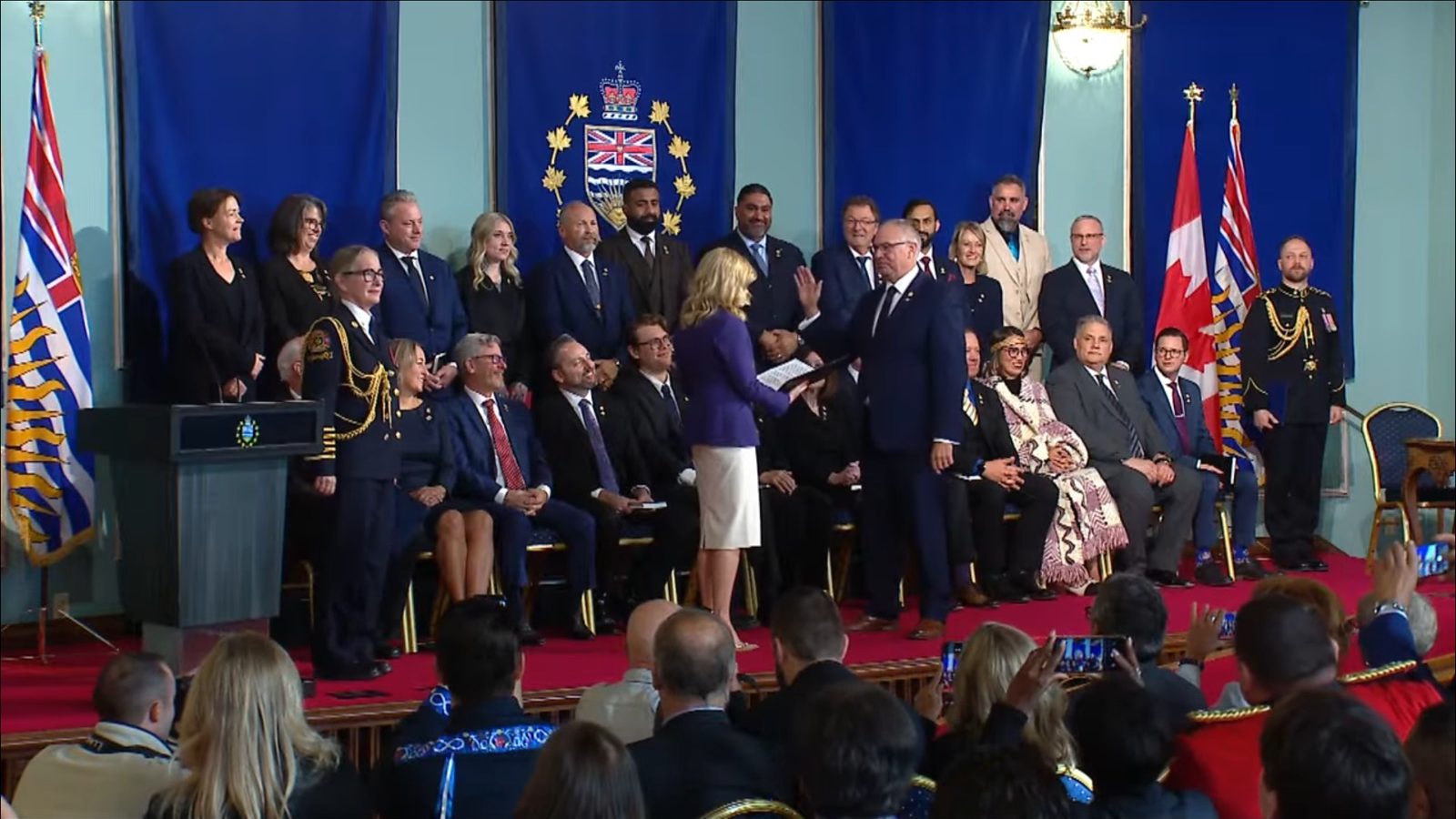
Premier Lorne Doerkson and his cabinet were sworn in today at Government House in Victoria by Lieutenant Governor Wendy Cocchia. His appointments and changes to the structure of government offer the clearest indication yet of how the new Conservative government intends to govern.
In his remarks following the ceremony, Doerkson linked economic growth to his government’s ability to lower taxes and fund the public services British Columbians depend on. The government has identified five priorities: affordability, prosperity, health, safety, and a strong and proud BC. The first budget will provide an indication of how it intends to deliver tax relief, improve services and restore fiscal discipline.
The premier also set an expectation for his government: “We will be accountable to British Columbians, not just for the commitments that we make, but for the results we deliver.”
A Smaller Cabinet, with Responsibilities Across Caucus
Doerkson’s 25-member cabinet includes the premier and six ministers of state, compared with 28 members in David Eby’s November 2024 cabinet. With 12 parliamentary secretaries also appointed, 37 of the 64 Conservative caucus members — nearly 58% — have formal government responsibilities, including the premier.
Ministers of state are members of the executive council, while parliamentary secretaries assist ministers but do not independently exercise ministerial authority by virtue of their appointment. The new structure allows the government to consolidate ministries while maintaining dedicated political attention to areas such as mining, housing, labour, emergency management, technology and innovation, seniors, tourism, and sport and culture.
Economic Growth and Government Reform
Peter Milobar, a former opposition finance critic and Kamloops mayor, becomes Minister of Finance. Gavin Dew takes on Economic Development and Tourism, with Carson Binda named Minister of State for Red Tape Reduction. Bruce Banman will oversee Citizens’ Services and Technology.
Kiel Giddens takes on Forests. Larry Neufeld will oversee Energy, Mines and Petroleum Resources, with Pete Davis as Minister of State for Mining. Bringing energy and mining together could help coordinate resource development and decisions about the power supply needed for new projects. Donegal Wilson takes on Water, Land and Natural Resource Operations, Ian Paton becomes Minister of Agriculture and Áʼa:líya Warbus becomes Minister of Environment.
Trevor Halford, the former interim party leader, becomes Minister of Transportation and Infrastructure. Korky Neufeld takes on Post-Secondary Education and Labour, with Harman Bhangu named Minister of State for Labour. Combining these responsibilities creates an opportunity to better align skills training, workforce needs and labour policy.
Experience and a Focus on Delivery
Ryan Peterson’s appointment as Minister of Health is noteworthy. A technology entrepreneur and former chair of the Business Council of British Columbia, he brings experience managing large organizations rather than a health care background. His appointment comes alongside the government’s commitment to protecting universal health care and improving access.
Caroline Elliott, a public policy consultant and former ministerial adviser, becomes Attorney General. Former police officer Jessy Sahota takes on Public Safety and Solicitor General, with Ward Stamer as Minister of State for Emergency Management. Claire Rattée becomes Minister of Social Development and Deputy Premier, Lynne Block takes on Education and Child Care, and Kristina Loewen becomes Minister of Children and Family Development. Loewen’s election result remains subject to a judicial recount.
That link between experience and responsibilities extends beyond cabinet. Former primary care executive Tracy St. Claire becomes Parliamentary Secretary for Rural Health; former construction project manager Misty Van Popta takes on Infrastructure; former RCMP officer Bryan Tepper takes on Urban Policing; and military veteran Rosalyn Bird takes on Armed Forces and Veterans Affairs.
Regional Representation and Partnerships
In his speech, Doerkson emphasized the economic ties between rural and urban BC. The appointments of Anna Kindy as Minister of State for Rural Development, Megan Knight as Parliamentary Secretary for Metro Vancouver and Harj Dhaliwal as Parliamentary Secretary for TransLink give both rural and metropolitan interests dedicated political representation.
Doerkson also identified local governments and First Nations as partners. Former municipal councillor Cathie Ounsted takes on Local Government, Housing, Sport and Culture, with Zeeshan Wahla named Minister of State for Housing. Scott McInnis takes on Indigenous Relations and Reconciliation, a file he held in Opposition. The government has explicitly identified economic partnerships with First Nations as part of its reconciliation agenda.
The Work Ahead
Six cabinet members are newly elected and eight are women. None has previously served in BC’s provincial cabinet. Experienced senior public servants, including Kim Henderson as deputy minister to the premier and cabinet secretary, and Tom McCarthy in policy and coordination, will help support the transition.
With no fall legislative sitting, ministers have the coming months to establish priorities and organize their ministries. The Speech from the Throne and Budget this spring will tell us more about how Doerkson intends to put his commitments into action.