
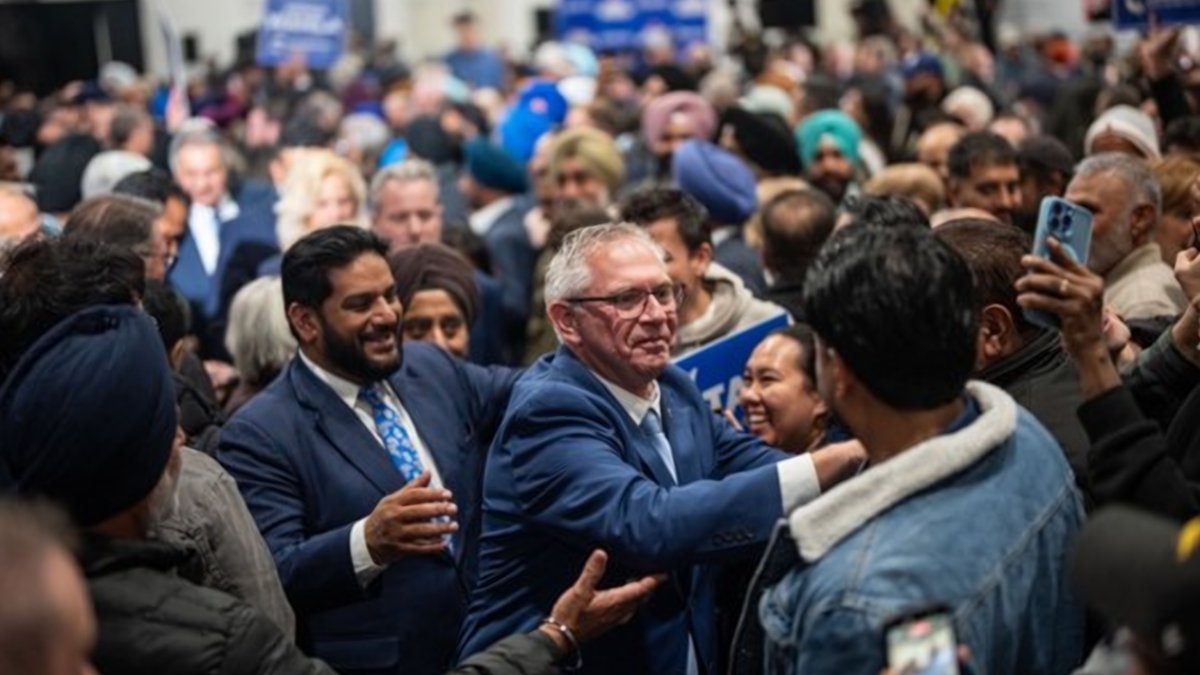
Lorne Doerkson has been elected British Columbia’s 38th Premier.
The BC Conservative Party secured a decisive majority, winning over 60 of the 93 seats in British Columbia’s Legislative Assembly. The New Democratic Party finished a distant second, forming the official opposition, while the BC Green Party maintained their seat count of two. Neither of the two smaller parties, CentreBC and OneBC, elected any MLAs.
Premier David Eby was re-elected in his own riding of Vancouver-Point Grey but announced in his concession speech tonight that he would be resigning as leader of the BC NDP.
For Doerkson, 58, the election victory caps an extraordinary five weeks. On September 20, he was returning from a trip to South Africa when his Conservative caucus colleagues asked him to assume the party’s leadership following the resignation of Kerry-Lynne Findlay. Within two days, 12 Conservative MLAs who had quit or been removed from the caucus during Findlay’s brief and tumultuous tenure returned to the fold. And just one day later, NDP Premier David Eby called a provincial election. Tonight, 34 days later, he is BC’s Premier-elect.
First elected in 2020 as the MLA for Cariboo-Chilcotin, Doerkson hails from Williams Lake, a resource-based community of just over 10,000 people in BC’s central Interior. He spent his early years in Surrey before his family moved to the Salmon Arm area. He moved to the Cariboo as a young man to find work and ultimately became the publisher of the Williams Lake Tribune.
Doerkson has a well-earned reputation for his strong work ethic and affable nature, both in his constituency and in Victoria. It was these qualities that enabled him to unite a caucus that had been exceptionally fractious and deeply divided since the 2024 election.
For Premier David Eby, the election results mark an end of 13 years of public service as an MLA, four as an Opposition MLA, five as Attorney General and the final four as Premier.
Clearly, Eby’s choice to call an early election, two years before his 2024 mandate was due to expire, was a critical miscalculation. In late August and early September when he first considered a snap election, he expected his Conservative opponent to be Kerry-Lynne Findlay, a self-described “true-blue conservative.”
His initial rationale for calling an election, to protect British Columbians from Donald Trump, would have resonated more strongly against Findlay. Instead, he found himself running against Lorne Doerkson, who is considered a more centrist conservative in the mould of the BC Liberal Party or the Social Credit Party.
The NDP campaign never found its footing. Mixed messaging over the rationale for calling a snap election in the midst of province-wide municipal elections, an initial anti-Trump message that failed to resonate and controversy over the Eby family’s use of the government’s $10-a-day childcare program, all contributed to a campaign that struggled to gain traction. In the end, British Columbians’ desire for change prevailed over concerns voters might have had about the Conservatives.
For Green Party Leader Emily Lowan, 26, the results mark the beginning of her elected career, with her first win in the riding of Saanich North and the Islands, the same community that has elected federal Green Party leader Elizabeth May since 2011.
One-time Conservative MLA Dallas Brodie, leader of the far-right OneBC party, was soundly defeated in Vancouver Quilchena, the province’s wealthiest riding where her repeated attacks on the heritage and culture of Indigenous Canadians were soundly rejected.
Another former Conservative MLA, Elenore Sturko, leader of the upstart CentreBC party for only a month, was defeated in Surrey South.
One topic that has received some attention is that Doerkson was appointed leader by the Conservative caucus and still carries the official title of Interim Leader. It is now expected that the BC Conservative Party will move quickly to make his leadership permanent.
What this Means
The Conservatives’ central economic message was to “supercharge the BC economy”: lower personal and business taxes, substantially expand natural resource development, accelerate major project approvals, and reduce regulation to stimulate private investment.
The test now will be for the Conservatives to turn those ambitious commitments into policies and actions that ultimately deliver results.
The Conservative platform is unusually specific about what its first budget would contain. It also commits to establish an independent fiscal review panel to provide an authoritative assessment of the province’s current finances before the first budget is tabled, likely to be delayed beyond February.
The platform commits to reducing the deficit every year and ensuring that operating spending grows more slowly than the economy. Under the Conservative plan the provincial deficit is projected to be $13.5 billion in 2027-28, falling to $10.8 billion by 2029-30.
The stimulative measures in the platform quickly add up: a $1,000 income tax cut per person, delivered by raising the basic personal exemption to $32,000, is costed at $2.9 billion a year, with $725 million allocated in the current fiscal year, while the three-year PST exemption on machinery, equipment and software adds another $500 million annually.
Those measures are to be financed almost entirely by spending restraint: the contingencies vote will be reduced from $5 billion to $3 billion, administrative and management hiring is frozen from day one, and spending on outside consulting and professional services contracts will be cut by 20 per cent. A “core review” — like one undertaken in the first year of the Gordon Campbell government — is planned for every ministry except for health, education, and the major social service ministries.
In total, operating spending is expected to be held essentially flat in 2027-28 at $97.9 billion compared with the $98.8 billion the NDP budgeted for the current year.
On the capital side, the platform commits to a six-month audit of the capital plan with broad competitive bidding to be restored. The only genuinely new capital commitments are $400 million for the acquisition of the province’s first dedicated wildfire aircraft fleet and funding for the planning of a Surrey women’s and children’s hospital.
For clients, the implication is that a Conservative first budget will likely close the door on new program funding for 2027-28 unless they are already identified in the platform.
Major BC Conservative Platform Commitments
- Energy development and LNG expansion: Double BC’s liquefied natural gas production by 2032 and triple it by 2035. Support new energy infrastructure, including pipelines, to expand exports, attract investment and create jobs.
- Personal income tax reduction: Increase the provincial basic personal exemption to $32,000, delivering up to $1,000 annually in provincial income tax savings.
- No new taxes: Commit not to introduce new provincial taxes or increase existing tax rates, positioning the party as an alternative to the NDP’s tax and spending policies.
- Eliminate PST on business investment: Remove the seven per cent provincial sales tax on purchases and leases of machinery, equipment, and business software for three years to stimulate private-sector investment.
- Accelerate major projects and reduce regulation: Introduce a 120-day permitting process for major projects exceeding $250 million, appoint a Minister for Red Tape Reduction and reduce regulatory requirements to 2017 levels.
- Infrastructure and construction: Replace the planned Massey Tunnel project with a bridge and build a new women’s and children’s hospital in Surrey. Support major infrastructure development and faster project approvals.
- Public safety and street crime: Hire 250 additional police officers, 500 RCMP officers and 50 Crown prosecutors; expand mandatory treatment for people with severe addictions and mental illness; and crack down on street disorder and repeat offenders.
- Healthcare reform: Maintain existing healthcare funding, recruit more doctors and nurses, establish a $50-million emergency fund to protect rural medical practices and launch an expert commission within 100 days to reduce wait times.
One other significant commitment worth noting: Doerkson has committed to repeal BC’s Declaration on the Rights of Indigenous Peoples Act (DRIPA), arguing that both have created an impediment to political and economic reconciliation.
Counsel Public Affairs’ experienced, multi-partisan team is ready to meet with you to discuss the public affairs challenges and opportunities that lie ahead because of the change in government.