The Alberta Legislature wrapped its fall sitting this week, concluding a session defined by significant policy moves, heightened political tension, and the continued rollout of Premier Danielle Smith’s agenda. Energy policy, affordability, healthcare restructuring, and jurisdictional autonomy dominated the floor, while the Opposition pressed the government on cost-of-living pressures, classroom capacity, and Alberta’s relationship with Ottawa.
Supported by a strong majority and a disciplined caucus, Premier Smith delivered a largely controlled session though not without its controversy. Health-care reforms, the use of the notwithstanding clause, recall petitions, the AHS procurement scandal, and the strain on the education consistently drove debate. The Alberta NDP, meanwhile, focused on fiscal challenges, the AHS procurement scandal, and pressure points in social services.
With major reforms underway and less than two years until the next provincial election, here is the fall sitting by the numbers.
14 bills introduced
The UCP government introduced and passed a suite of bills during the Fall 2025 session aimed at asserting provincial jurisdiction and advancing its policy priorities. Highlights include:
- International Agreements Act (Bill 1): Replaces previous trade-implementation legislation and requires Alberta-specific legislative action before international agreements with provincial implications can take effect.
- Back to School Act (Bill 2): Ended the Alberta Teachers’ Association strike by ordering 51,000 teachers back to the classroom, imposed a four-year contract, and invoked the notwithstanding clause. Under the new agreement teachers received:
- legislated wage increases (e.g. roughly 3% per year) under the imposed contract;
- minimum substitute pay, northern/remote allowances, and ;
- a commitment to hire 3,000 additional teachers and 1,500 educational assistants over a multi-year period.
- Private Vocational Training Amendment Act, 2025 (Bill 3): Modernizes oversight for private training institutions and enhances student protections.
- Public Safety and Emergency Services Statutes Amendment Act, 2025 (No. 2) (Bill 4): Advances the Alberta Sheriffs Police Service, strengthens law-enforcement authorities, and enhances Clare’s Law reporting.
- Water Amendment Act, 2025 (Bill 7): Updates water licensing, expands reporting transparency, and allows more flexible use of alternative water sources. Critics warn of environmental governance risks.
- The Health Statutes Amendment Act, 2025 (Bill 11): Introduces a dual practice model that allows physicians to work in both the public system and approved private settings while remaining compliant with the Canada Health Act. The changes are intended to expand system capacity by giving providers greater flexibility in how they deliver services, while maintaining public coverage for medically necessary care.
21 MLAs face recall petitions:
As of this session, 21 UCP MLAs are subject to active recall petitions. This is an extraordinary development in Alberta politics.
This surge in recall activity reflects more than dissatisfaction with individual MLAs. It points to:
- Erosion of trust among segments of the electorate;
- Growing activism around government decisions on health care, education, and federal–provincial relations; and
- A potential test of the UCP’s internal stability and caucus discipline.
Nearly one in five UCP MLAs now face recall attempts. It’s a dynamic that could reshape constituency politics heading into 2027.
404,293 verified signatures on the Forever Canada petition
Debate over Alberta’s place within Confederation continued to dominate the political narrative throughout the fall, following months of province-wide engagement through the government-driven Alberta Next panels. Throughout the fall, the UCP leaned heavily into themes of economic, constitutional, and cultural autonomy. It is messaging that continues to resonate with a portion of the electorate seeking greater provincial control.
At the same time, the anti-separatist Forever Canada petition has emerged as one of the most significant grassroots political mobilizations in recent Alberta history. Elections Alberta recently verified 404,293 signatures, reflecting a broad-based effort led by volunteers and ordinary Albertans. The petition poses a politically charged but straightforward question: “Do you agree that Alberta should remain within Canada?” Its organizers positioned it as a democratic counterweight to rising separatist sentiment within the province.
For the government, this development presents both opportunity and risk. While discussions about provincial sovereignty align with the UCP’s jurisdiction-focused agenda, the scale of public engagement suggests the debate may evolve in ways that extend beyond government framing or control.
One Pipeline MOU
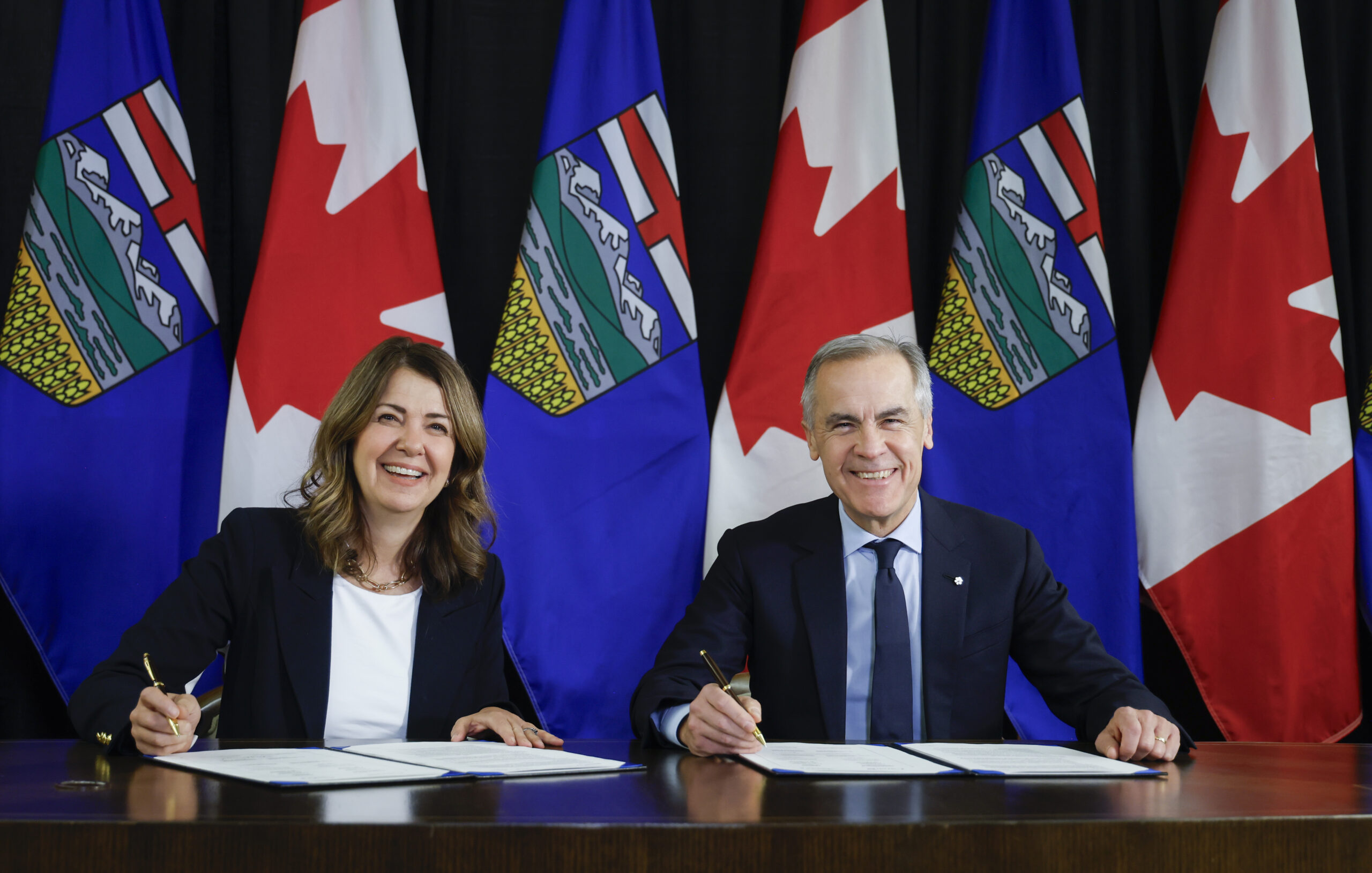
The government advanced its jurisdictional and resource-development priorities through the signing of a new pipeline-related memorandum of understanding (MOU) with the Government of Canada, reinforcing Alberta’s focus on market access and long-term infrastructure certainty. The MOU signals the province’s intent to pursue expanded export capacity, align regulatory pathways with key partners, and position Alberta to compete more effectively in North American and global energy markets. While details will continue to evolve, the agreement reflects the government’s commitment to supporting investment, reducing bottlenecks, and strengthening the policy environment surrounding future pipeline and midstream projects.
The business and investment community are applauding these efforts, while sovereigntists are using this to signal more of the same talk and not action with Ottawa. This lack of enthusiasm was on display at the UCP annual general meeting in late November where separatist delegates booed the Premier during her remarks lauding the MOU with Ottawa. It’s become a tricky balancing act for the Premier as many disaffected types are UCP supporters fighting these policies from within the tent.
A $6.4-Billion Deficit (for 2025–26)
The fall fiscal update revealed Alberta is now forecasting a $6.4-billion deficit—a deterioration from the original Budget 2025 estimate.
Key drivers include:
- A 30% drop in natural-resource revenues, driven by lower global oil prices (forecast ~US $61.50/bbl)
- Rising expenses tied to recent labour settlements, including $881 million drawn from contingency funds
- A return to structural deficits, reversing years of surpluses
Total revenues are projected at $73.0 billion, with expenses at $79.4 billion.
What is Next? A Volatile 2026 Ahead
As Alberta wraps up its 2025 fall legislative session, attention is already shifting to how the Smith government will navigate a politically volatile new year. Traditionally, Albertans could expect a Throne Speech in February and a budget shortly thereafter. The UCP will need to carefully address ongoing affordability pressures, softening energy revenues, and continued demands for major public sector investments.
But the political landscape heading into 2026 is unusually unsettled.
The Recall Act has become one of the defining storylines of 2025 with petitions targeting both the UCP and an Opposition MLA, generating sustained media scrutiny. Even when unsuccessful, these petitions have served as a proxy for broader public frustration on issues from healthcare wait times to education system strain to the government’s approach to federal-provincial relations. This level of recall activity now hangs over government benches and has the potential to shift constituency-level dynamics through the latter half of the mandate.
This mix of instability and opportunity presents Premier Smith with competing pressures: reasons to proceed cautiously, and reasons to act decisively.
On one hand, the UCP enters 2026 with notable strengths including a well-resourced central party organization, a legislative agenda that has been sharply focused on autonomy, resource development, and cost-of-living relief issues that continue to resonate with core supporters.
At the same time, the government must consider the political implications of its fall legislative package, including changes to labour law, municipal authority, and education governance. While applauded by parts of the conservative base, several of these measures have galvanized opposition from school boards, municipalities, unions, and civil society groups; that will remain highly mobilized into 2026.
As Alberta prepares for a pivotal year of policymaking, fiscal recalibration, and political volatility, organizations will need clear strategies to engage government, anticipate risk, and capitalize on emerging opportunities.
Counsel Public Affairs is well positioned to support your Alberta government relations goals in 2026. If you’re looking to advance your priorities, we can help your organization navigate the landscape with insight, precision, and strategic engagement.