

Alberta Budget 2026: Stability under Strain
Growth and the Politics of Fiscal Balance
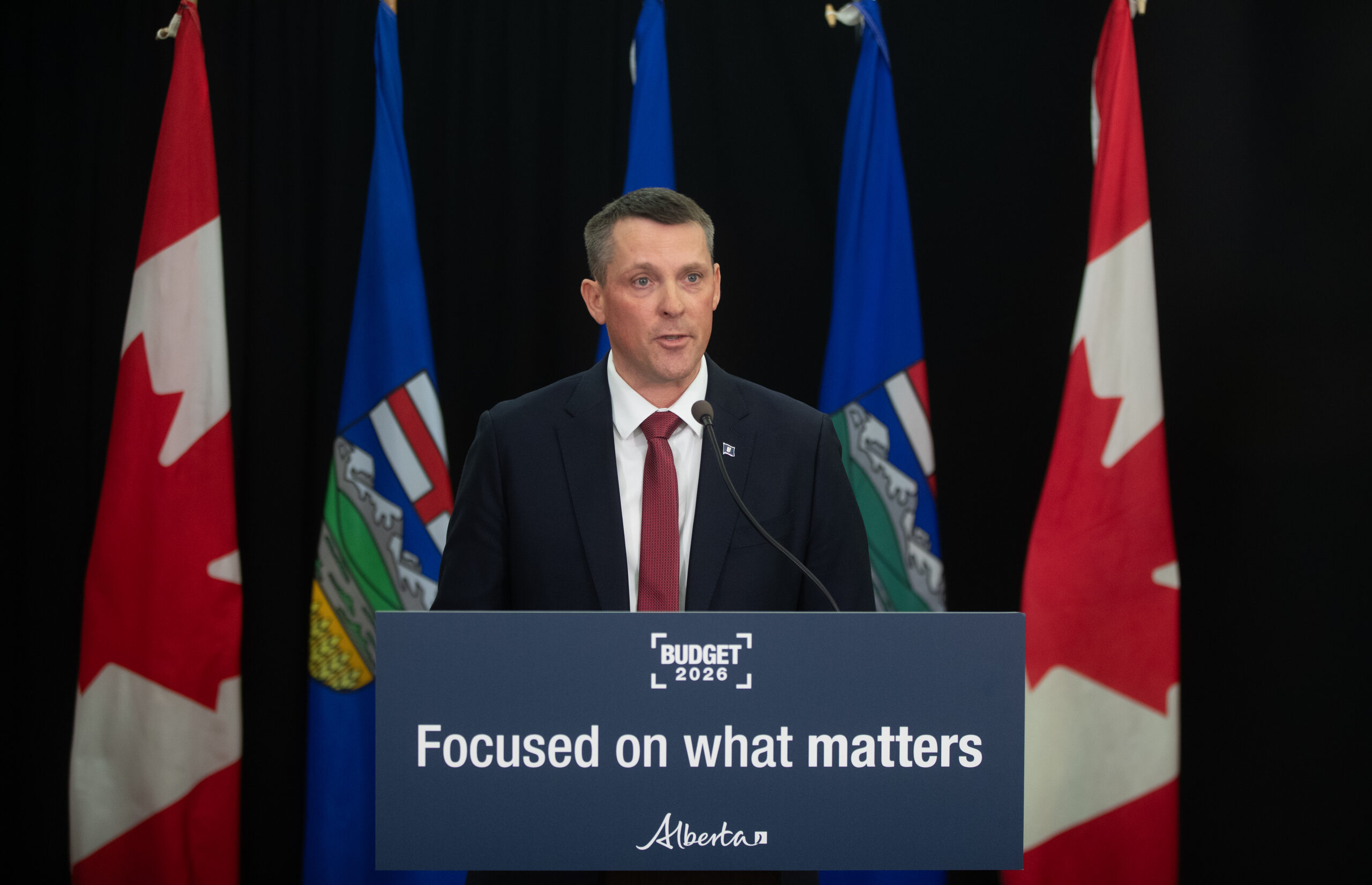
Finance Minister Nate Horner tabled Alberta’s 2026 Budget today against a backdrop of moderating oil prices, global trade uncertainty, and sustained population growth pressures.
The government projects a $9.4 billion deficit in 2026–27, with revenues of $74.6 billion and expenses of $83.9 billion. The government’s fiscal path shows declining but persistent deficits of $7.6 billion and $6.9 billion over the following two years.
Counsel Public Affairs was on the ground for the budget release. Here is what stands out, and what it means for Alberta stakeholders.
The headline figure in Budget 2026 is the projected $9.4 billion, $7.6 billion and $6.9 billion deficits over the next three years.
Key fiscal metrics:
- WTI oil forecast: US$60.50 (2026-27)
- WCS oil forecast: CND $65.30 (2026-27)
- Real GDP growth forecast: 1.8% (2026)
- Expense growth rate: 5.6% in 2026–27
- Net debt-to-GDP ratio: 7.2% (2024–25 actual)
- Contingency allocation: $2 billion
This fiscal plan depends on steady oil prices, moderated population growth, and restrained spending growth after this year’s jump.
The durability of the outlook hinges largely on commodity price stability, given its reliance on oil prices. A sustained drop below the $60 WTI assumption would quickly widen the structural deficit gap.
Revenue Assumptions: Conservative or Confident?
Total revenue is projected at $74.6 billion, including:
- Non-renewable resource revenue: $13.2 billion
- Personal income tax: $15.9 billion
- Corporate income tax: $7.3 billion
- Federal transfers: trending upward toward $13.8 billion by 2028–29
The oil price assumption of US$60.50 WTI is broadly aligned with current private sector forecasts but remains vulnerable to global volatility. With a hit to the province’s coffers of $3.1 billion year-over-year as a result of declining resource revenues, Alberta’s fiscal outlook is once again tightly tied to commodity performance.
Restraint by Design: Navigating the 2026 Budget Squeeze
The tone of Budget 2026 is restrained but politically calibrated. While the path to balance remains undefined beyond the three-year window, the government avoided broad-based tax increases and instead emphasized preserving Alberta’s relative tax advantage and growing the Heritage Fund to $250 billion by 2050. Spending growth is concentrated in politically and structurally sensitive areas including $34.4 billion in health (+$1.9B), $10.8 billion for education (+7.2%), and a $28.3 billion three-year capital plan featuring $4.9 billion in health infrastructure.
At the same time, taxpayer-supported debt rises to $108.9 billion, with annual debt servicing costs increasing to $3.4 billion. With the 2027 provincial election on the horizon, the budget appears designed to stabilize the fiscal narrative, by retaining the personal tax cuts implemented last year and expanding core services while avoiding austerity.
Spending Priorities: Health, Education, and Infrastructure
The government will continue investing $1.9 billion in new health funding to reduce wait times, expand cancer care and accelerate transition out of acute care beds. The plan continues implementation of the refocused health model, with four integrated provincial health agencies and the creation of Health Shared Services to centralize administrative functions. The government is attempting to increase front-line capacity while finding administrative efficiencies.
Education will see $722 million in new funding for enrolment growth, teacher compensation, and classroom supports. Record student growth is driving hiring and operational expansion, but the province is also emphasizing targeted seat expansion in high demand post-secondary programs to support labour market needs. Workforce development is being treated as an economic infrastructure anchor. Funding is tied to classroom stabilization and to long-term labour market alignment in trades, health professions and critical labour positions that will support the growth of Alberta’s economy.
Infrastructure is another anchoring pillar for spending growth. The three-year capital plan totals over $28 billion with major allocations for health facilities, school construction, and municipal infrastructure. Additional investments in transportation corridors, capital maintenance and renewal, and post-secondary facilities are intended to strengthen Alberta’s infrastructure economic competitiveness. With the province still absorbing the aftershocks of record migration, capital spending is the crucial prerequisite for further growth.
Intergovernmental Tension: Ottawa in the Margins
While not overtly confrontational, the budget quietly reinforces Alberta’s sovereignty posture.
Themes of defending jurisdiction over energy, electricity regulation, industrial emissions policy, and international agreements run throughout the strategic plan.
At the same time, population growth projections are moderated by federal immigration policy changes. This is an implicit acknowledgement that Ottawa continues to shape Alberta’s economic trajectory.
What Albertans Should Watch
- Oil Price Sensitivity: With WTI assumed at US$60.50, further softening would materially affect revenue projections.
- Health System Modernization: The scale of investment, including $1.4 billion in acute care capital spending and major addiction and EMS allocations, signals continued structural reform and procurement activity.
- Capital Execution Risk: The $28.3 billion capital plan will test government delivery capacity in a high-cost environment.
- Debt and Borrowing Costs: As debt servicing rises, pressure to contain program spending will intensify beyond 2026–27.
- Election-Year Framing: Expect continued emphasis on Alberta’s low tax burden, net debt advantage (7.2% debt-to-GDP), and economic diversification narrative.
As Minister Horner framed it in closing, “When a tough season hits, Albertans never throw in the towel.”
Budget 2026 is positioned as a bridge. It maintains Alberta’s comparative fiscal strengths while absorbing the strain of lower resource revenue and elevated service demand.
Whether it proves a stabilizing pivot or a holding pattern will depend on oil markets, execution discipline, and the political calculus heading into 2027.