

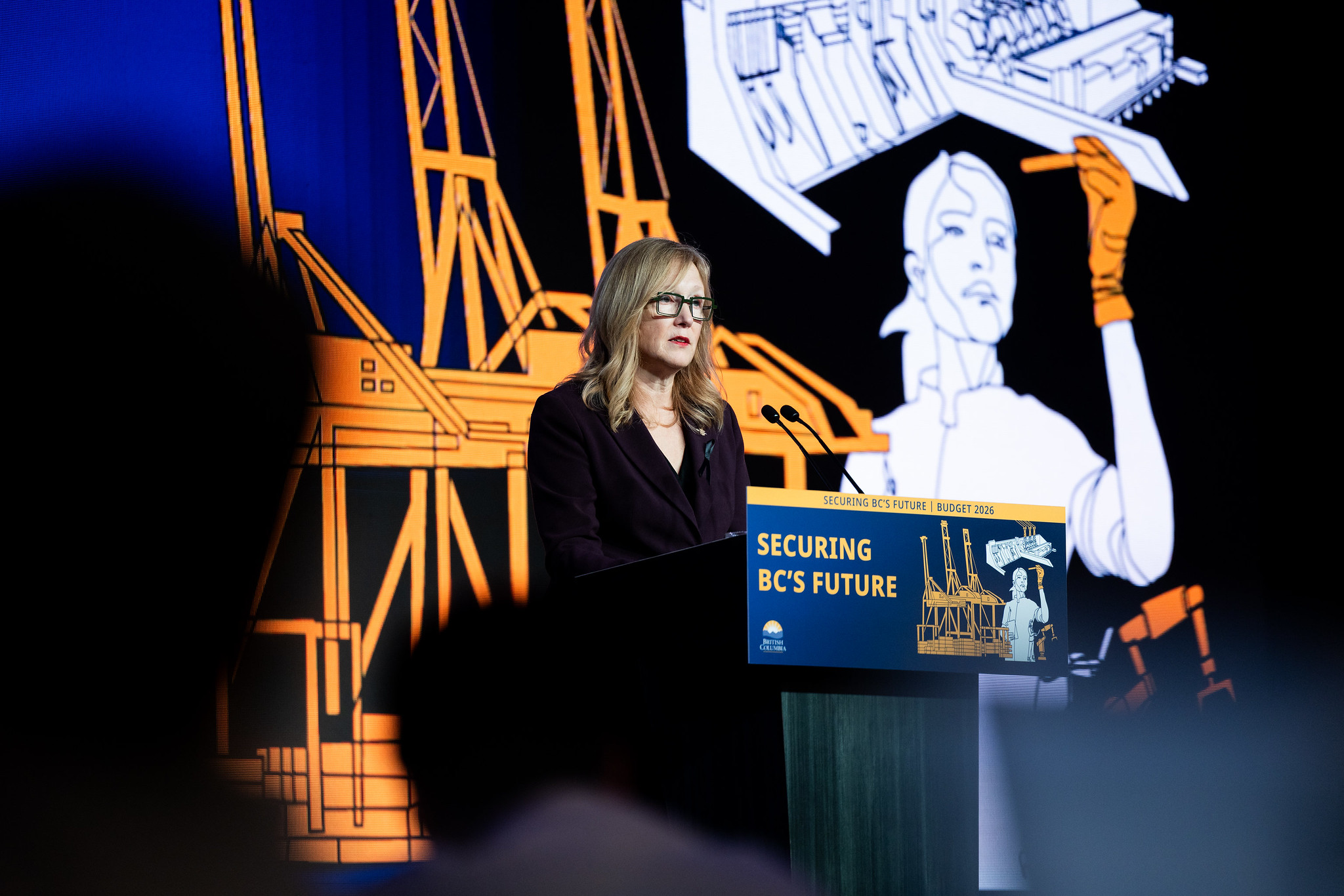
Like all her colleagues across Canada, BC Finance Minister Brenda Bailey faced economic turmoil driven by Donald Trump and increased fiscal pressure as she prepared the provincial budget for 2026-27.
For weeks, Bailey and Premier David Eby signaled that this would be a bad news budget as the government deals with a long-term fiscal path that Shannon Salter, the head of BC’s Public Service, referred to as “unsustainable.” Bailey even mused that she would be the least popular person in BC after the budget was tabled.
On Tuesday, the bad news was muted, with Bailey announcing strategic funding increases in core areas like health care and education while introducing modest tax increases and cost-containment measures.
Counsel Public Affairs’ BC team was on the ground at Budget 2026. Here are the details on the province’s fiscal blueprint and what it means for you.
A Holding Pattern Built on Future Growth
Budget 2026 is not the bad news budget many expected. There is no sweeping tax hike, deep program cuts or a structural rewrite of the fiscal framework. Instead, government has chosen a middle path that protects core services, introduces modest revenue increases, and relies on growth from major projects to narrow deficits over time. That approach only works if several assumptions prove true. This budget is less about what government is doing today and more about what it is betting on tomorrow.
The Core Bet: Avoiding Negative Shock
The economic forecast underpinning the budget is modest. It projects real economic growth of 1.3 per cent in 2026 rising to 1.8 per cent in 2027, with average growth of 2.1 per cent through the end of the decade. This is not a high-growth recovery scenario. It is a slow and steady outlook.
For the fiscal plan to hold several things must happen:
- There cannot be a recession.
- U.S. trade tensions cannot materially worsen.
- Immigration reductions must stabilize rather than deepen.
- Commodity prices must not collapse.
The deficit remains large. It is $13.3 billion in 2026-27, declining gradually to $11.4 billion by 2028-29. That path depends on modest economic growth continuing uninterrupted. This is a budget built on containment. It assumes turbulence in the years ahead, but that an economic crisis will be avoided.
The Fiscal Strategy: Spread the Pain, Avoid the Shock
Government opted against large income tax hikes or sharp spending cuts. Instead, it broadened the PST base, nudged up the lowest income tax bracket, paused bracket indexing, and modestly increased high-value property taxes.
The strategy is clear. It seeks to stabilize revenue without spooking capital or voters. But the revenue measures alone do not close the fiscal gap. They only slow its growth. The plan depends on economic expansion, particularly in major projects, to strengthen the revenue base over time.
That makes the growth file central to fiscal sustainability.
The $400 Million Signal: Major Projects Must Land
The most strategically important measure in the budget is the $400 million Strategic Investments Special Account. This is not a stimulus program. It is a positioning tool.
It allows the province to align itself with Prime Minister Mark Carney’s economic strategy to ensure the success of large projects including large-scale mining, LNG, clean energy transmission, and other industrial projects. This approach builds on the Look West major projects strategy announced last fall.
To succeed several things must happen:
- New LNG investment must proceed.
- The North Coast Transmission Line must advance on schedule.
- Mining expansions must reach final investment decisions.
- Permitting reforms must continue reducing timelines.
In short, the success of the fiscal plan is predicated on the need for projects to proceed to create jobs and to improve government revenues. If projects stall, the fiscal math deteriorates. The growth story is not optional; it is structural to the deficit path.
Expenditure Management: Administrative, Not Frontline
The commitment to reduce the size of the public service by 15,000 positions is significant, but the government has framed it carefully. It remains committed to ensuring that cuts do not come at the expense of front-line delivery service where it will continue to add positions. Instead, it is focused on reducing management and administrative positions either through attrition or through voluntary retirements and buy outs.
On changes to the capital plan, it is not reducing the number of projects. Instead, it is spreading them out over time, in part to ensure it is not competing with itself over project approvals and, in turn, increasing costs.
For this plan to succeed, the government must remain true to its commitment to not make staff reductions that are visible to the public in hospitals and schools. In addition, wage settlements in negotiations with nurses and paramedics must be in line with the settlement made this fall with the BCGEU.
Capital Re-Pacing: Managing Debt, Not Retreating
Re-pacing nine health and long-term care projects and reallocating $1.4 billion signals fiscal caution. The government is managing construction inflation and addressing concerns about its debt-to-GDP ratio, which has been on the rise in recent years. But debt still rises to $189 billion by 2028-29.
The budget assumes stable capital markets. That is an external dependency that means counting on:
- Borrowing costs not spiking.
- BC’s credit rating holding.
- The debt-to-GDP ratio remaining competitive nationally.
What Clients Should Watch
For resource, energy, and major infrastructure clients, the key takeaway is this: the government has tied its fiscal future to major project delivery. This is not an austerity budget. It is a bridge budget. It assumes that trade volatility stabilizes, immigration normalizes by the end of the decade, major projects advance and capital markets remain stable.
If those conditions hold, the deficit declines gradually. If they do not, government will face harder decisions future budgets.
Bottom Line
Budget 2026 is disciplined but not disruptive. It protects core services, spreads modest tax increases broadly, and bets on growth from big projects to repair the fiscal outlook. The tone may feel underwhelming, but the implications are not.
This is a government that has decided not to cut its way out of fiscal pressure and not to tax aggressively its way out either. Instead, it is relying on the assumption that economic development will do the heavy lifting. That is the bet embedded in this budget.