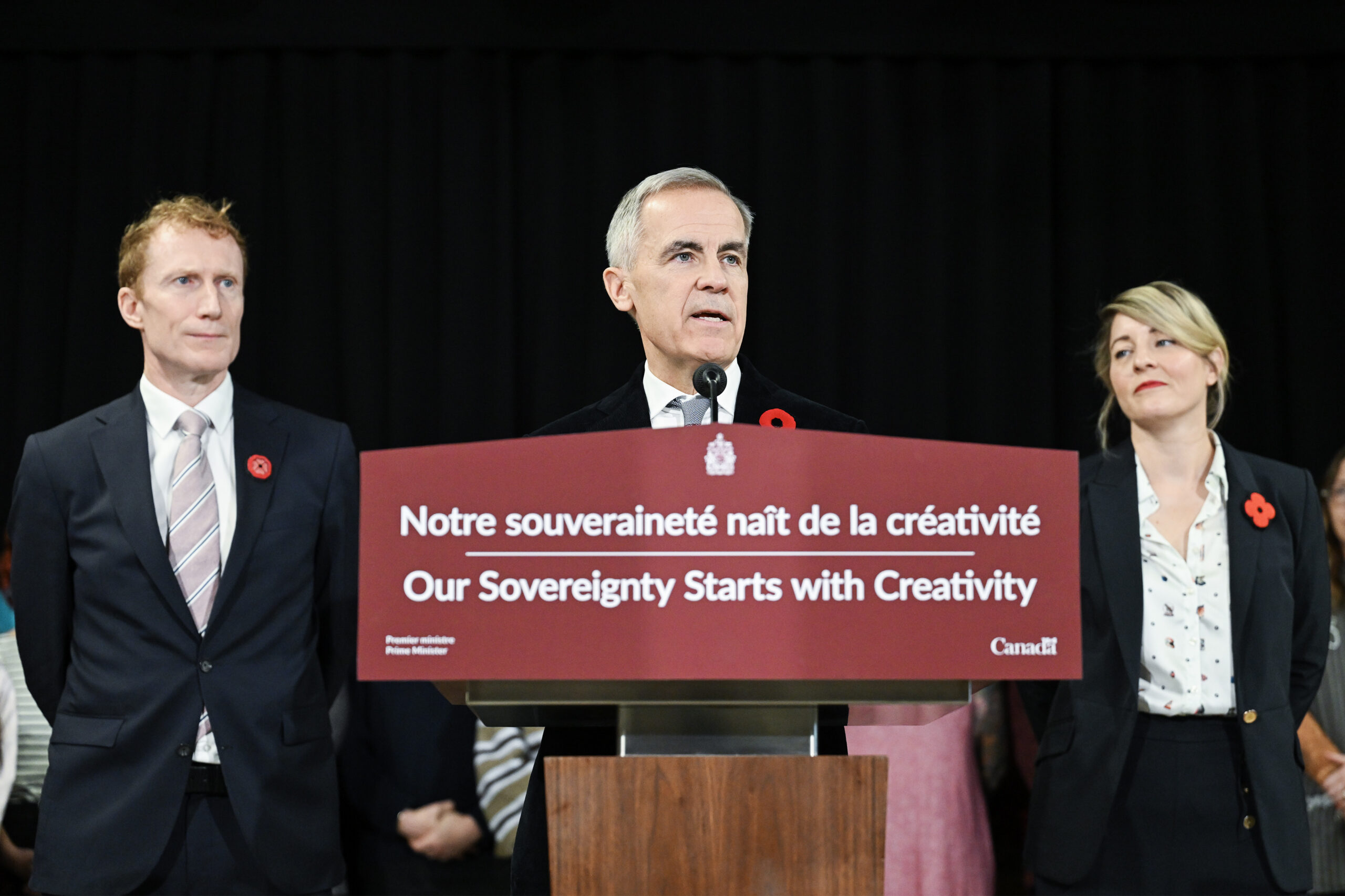
The Carney government’s second budget includes $4B in arts and culture measures. This week, Prime Minister Carney and multiple Ministers made public appearances emphasizing the government’s investment in culture.
As a former arts administrator and avid supporter, I am thrilled to see this investment. With most of these measures billed under “A Strong and United Canada,” and public appearances emphasizing “Our Sovereignty Starts with Creativity,” I’m also pleased to see the government recognizing the essential role of arts and culture in a thriving, unified society.
Arts and culture – including museums and heritage sites, cultural centres, TV and film, performing arts, visual arts, and more – are essential to human life. From cave paintings to modern blockbusters, we are a storytelling species. Culture is not just entertainment Investing in culture can achieve two goals that Canada desperately needs right now:
- Build community, empathy and resilience in time of societal division and fear bred by the crises of affordability, climate change, global conflicts, and AI-driven rapid change.
- Build cultural identity as we nurture a Canada with greater independence from our southern neighbour.
Those of us passionate about the arts are often hesitant to make an economic argument for their support, preferring to focus on the intrinsic and societal benefits. Yet the cultural sector also contributes significantly to Canadian GDP, supports international relationships and economic gain through cultural exports, creates jobs, and brings returns on government investment that outpace other industries (see more from the Canadian Chamber of Commerce).
All of these benefits require a thriving arts and culture sector. Canada has fantastic artists and arts organizations. We produce art that is recognized globally. But the truth is that making a living in culture is a constant struggle. Most artists and arts workers are underpaid and live in a state of uncertainty as they move between contract gigs. Well-paid, permanent positions are few and far between. Dozens of small non-profits also provide immense community benefit while fighting for the same small pile of donations and grants.
All this considered, it is worth taking a closer look at the arts and culture promises made in Budget 2026, and the policy work needed to ensure they make a difference for the sector.
Topline: The $4B billed under arts and culture includes investments towards artists, museums, and historic sites, as well as recreational facilities and ice rinks, national parks, trails, the 2028 Francophone Summit, and journalism. All of these are worthy investments that will absolutely contribute to a strong and united Canada. Only a few will make a meaningful impact for the arts and culture sector. I’ll focus on the most directly impactful, and set aside the positive, secondary impacts of investment in related areas like community spaces and Canadian media.

Canada Creative Credit and Tax Measures
Budget 2026 announced two tax measures for artists. The first is the removal of a $1,000 cap on deductible expenses. This will allow artists to claim more eligible expenses and simplify filing – both important changes for overstretched artists.
The second is the Canada Creative Credit, a new personal tax credit for artists. This credit will directly support the individuals who actually make the music, theatre, dance, movies, visual art, and more that bring us joy, challenge our assumptions, and share Canadian stories.
The Budget notes that the Creative Credit “combined with the Basic Personal Amount, [would] provide tax recognition on up to $45,000 of annual qualifying net business income derived from original and creative artistic works.” More details are to come in the Spring Economic Update.
Artists and arts professionals have been quick to both praise this measure and point out that the devil is in the details. Significant industry consultation will be needed, as the specific parameters of this credit will greatly affect the extent to which it will actually support artists and bolster the industry.
For example, if an actor or dancer is paid as a member of an ensemble, is that considered income from “original and creative artistic work”? What about teaching an art class? Do grants supporting artistic work count as qualifying income? Will the average, overstretched artist be able to file without getting lost in paperwork or requiring an accountant?
Museums
Budget 2026 includes a number of measures for museums and heritage institutions, including:
- Extending the Canada Strong Pass, which provides discounted access to museums and heritages sites, and expanding access to Indigenous-led museums and cultural centres.
- Permanently making admission to national museums free to youth under 25.
- Providing direct investment in national museums and galleries.
These are impactful investments that should foster greater engagement with and sustain our important cultural institutions. The direct investment, committed over four years, is much needed to sustain large institutions that have struggled with stagnating funding.
Data consistently shows that early interaction with culture fosters lifelong engagement. Free admission for youth is an admirable program that should boost attendance for institutions and build that lifelong curiosity among young people. Unfortunately, most of the museums and institutions that will qualify for the free youth program are in Ottawa. Provincial governments would have to step up to expand this program to institutions like the Royal Ontario Museum, the Vancouver Art Gallery, or smaller, local museums.
Canada 160:
The budget includes $325M (including $100M in existing departmental funds) towards Canada 160 celebrations. This $325M will include support for:
- Heritage Minutes
- The Trans-Canada Trail
- Community spaces through the existing the Build Communities Strong Fund
- Festivals and performing arts events through the Building Communities through Arts and Heritage program and Canada Arts Presentation Fund.
For the arts and cultural sector, additional funds for festivals and performing arts events is the most consequential of these Canada 160 investments. I worked in the arts during Canada 150 and saw firsthand the opportunities that arose from it. Artists and cultural organizations were able to access funding to run unique and impactful community programs. I’m glad to see this renewed for Canada 160.
That said, artists and organizations need sustainable, long-term funding. One-time funding tied to a specific cultural event can foster creativity and give new artists a chance for a paid gig. But it can also limit creativity by funding only those activities that fit the Canada 160 brief, and will not sustain lasting cultural activity in Canadian communities.
What will sustain cultural activity is long-term, predictable funding for programs like the Canada Arts Presentation Fund, and for the Canada Council for the Arts. Despite the $4B headline for culture in this budget, the sector continues to decry the failure of funding for the Canada Council to keep up with inflation and cost of living, let alone support the government’s cultural sovereignty ambitions.
What’s Next?
From this $4B investment, to Canada’s participation in Eurovision, this government has clearly conveyed a vote of confidence in arts and culture as an important part of its bid to disentangle from the U.S. and “build Canada strong.” Like most Budget announcements, there remain many details to be fleshed out in legislation and program design. The sector has an opportunity to influence these critical details, and encourage the government to address omissions through effective and creative advocacy. After all, creativity is what the sector is all about.
If you are part of an arts or cultural organization, institution, or company, the federal team at Counsel Public Affairs can help you to make the most of this moment and advocate for the long-term investments and policy shifts that will create stability and allow Canadian stories room to thrive.
Recently, I had the pleasure of attending the 2026 Healthcare Communications Conference, which gathered communicators from hospitals, associations, care providers, and healthcare organizations from across Canada. These communicators are working in uniquely high stakes, often literally life or death, environments. The hills and valleys they must navigate are steeper than most, vacillating between inspiring stories and high-profile crises. They are also aware of the vital importance of their work and its place in the larger healthcare context: communication is clinical care. From vaccine awareness to fundraising efforts, effective communication directly impacts the way patients experience healthcare, and their outcomes.
Whether you would classify yourself as a professional communicator or not, you are part of telling your organization’s story and building key relationships. Here are four lessons from healthcare communicators that may help you communicate with greater clarity and purpose:
- Starting with Data: The best decisions are grounded in data. This is truer than ever in today’s era of misinformation. That’s why Counsel has a dedicated research team, and that’s why I was pleased to hear data raised again and again at the Healthcare Communications Conference. Healthcare communicators get it. They are out there talking to their partners, verifying their assumptions, and genuinely listening to the needs of their communities. They know that without data, they are pouring scarce resources into a strategy that might be built on assumptions, not fact. (For more on this, see this piece from Counsel’s Stephanie Coulter on using research to inform strategy.)
- Building Message Clarity Beyond the CEO: Strong internal relationships also allow healthcare communicators to ensure that brand consistency and authentic key messages are carried through the whole organization. At Counsel, we often advise clients to shift their thinking: instead of providing media training only to the CEO, we encourage them to deliver communications training to senior leadership. Leadership should then take those lessons to the rest of the team, empowering everyone in the organization to carry the narrative.
Inisghts by:

Natalie Dewan
Senior Account Director