
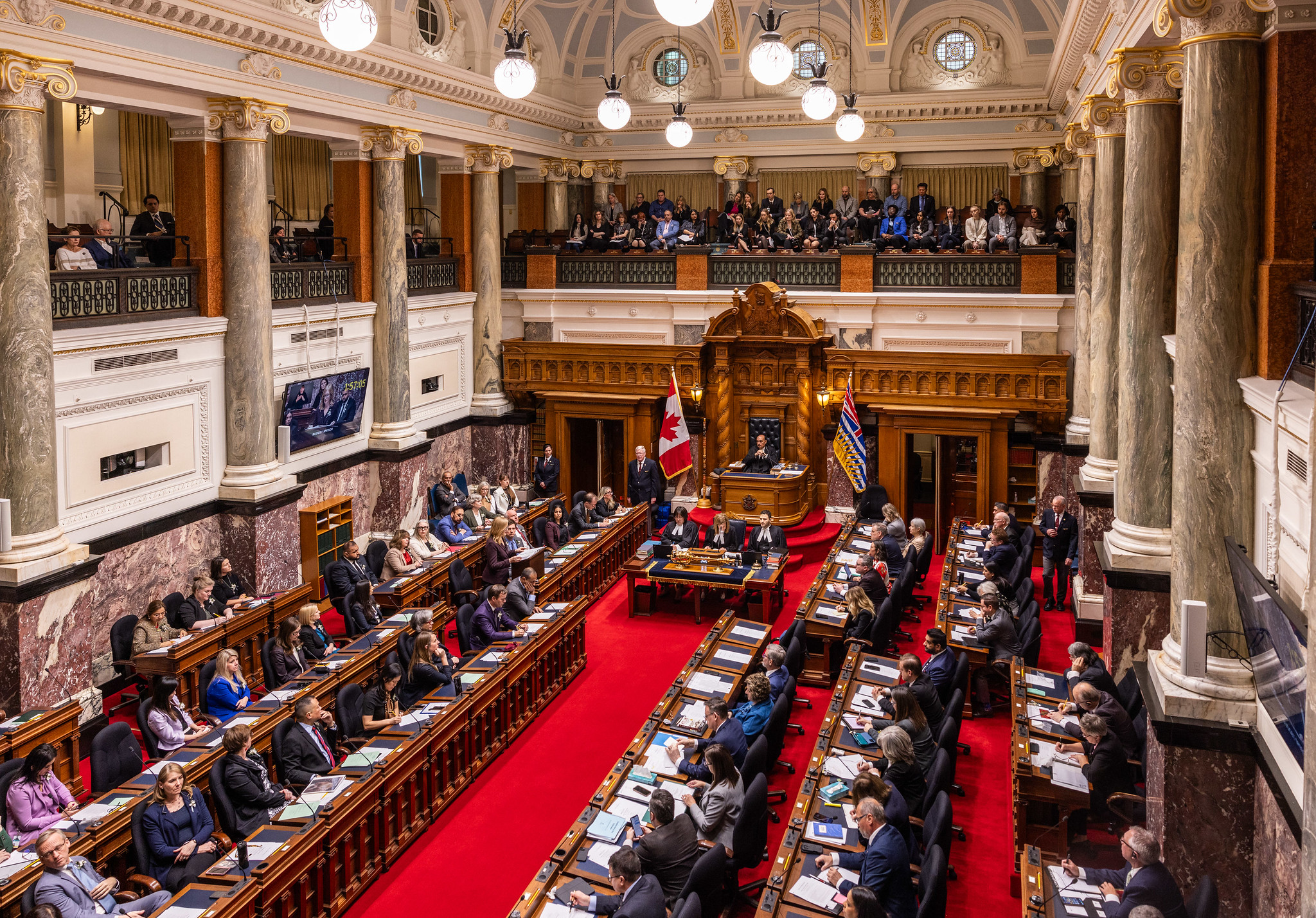
British Columbia’s tumultuous legislative session ends today with the House rising until Oct. 5.
It began with a rare moment of unity as all parties in the Legislature came together in mourning following the mass shooting in Tumbler Ridge that claimed nine lives, including the shooter.
Days later, the tone shifted sharply back to politics when Finance Minister Brenda Bailey tabled a $13.3-billion deficit budget that promised to protect core services like health care and education while drawing criticism over delayed hospital and long-term care projects.
Over the months that followed, the government introduced 21 bills, but much of the session revolved around two broader pressures: affordability and the future of the Declaration on the Rights of Indigenous Peoples Act (DRIPA).
The session now ends with many of its biggest political questions unresolved. The BC Conservatives are preparing to choose a new leader on May 30. Alberta separatism continues to ripple across Western Canada. And Premier David Eby’s New Democrats are assessing what comes next after their most difficult legislative session since John Horgan’s breakthrough victory in 2017.
Last year, Counsel Public Affairs looked back at the defining moments, issues and performances of the legislative session. This year, we return with another unofficial awards season recap from the BC Legislature.
Most significant legislative issue: DRIPA
Passed unanimously in 2019 as part of the province’s reconciliation efforts with Indigenous peoples, DRIPA became the defining political and legal issue of the spring session.
Late last year, the BC Court of Appeal ruled that the province’s current mineral claims system was inconsistent with the legislation, immediately raising broader questions about permitting, resource development and Indigenous consent.
Premier David Eby’s government found itself under pressure from every direction. Conservatives called for repeal. First Nations leadership and the BC Greens pushed government to maintain the legislation and its underlying commitments. Industry groups warned about growing uncertainty around investment and project approvals.
The government responded by appealing the ruling while also signalling that amendments to DRIPA itself may be necessary. Although Eby and the First Nations Leadership Council later issued a joint statement committing to work together on a path forward, the issue continued to dominate Question Period through the final weeks of session.
Last week, the Supreme Court of Canada agreed to hear the province’s appeal. The legal process may now stretch on for months, but the political pressure surrounding DRIPA is unlikely to ease before the Legislature returns this fall.
Honourable Mention: None. While the government introduced 21 bills this session, nothing else comes close.
Biggest political story: BC Conservatives leadership
Every leadership race reveals something about the party holding it. The BC Conservatives’ contest revealed a movement still deciding exactly what it wants to become.
At what should be a moment of momentum for the party, with strong fundraising numbers and growing support in public polling, much of the spring instead exposed tensions between candidates and supporters aligned with the former BC Liberals and a newer populist wing pushing the party in a different direction.
On Saturday, May 30, party members will choose a new leader. Whether that person is Kerry-Lynne Findlay, Caroline Elliott, Iain Black, Peter Milobar or Yuri Fulmer, the challenge ahead will be the same: unite a rapidly growing coalition while convincing voters the Conservatives are prepared to govern.
The stakes extend well beyond the party itself. For decades, BC politics has often turned on whether the province’s fractured right-of-centre coalition could successfully come together under one banner. Depending on the outcome, this race may mark the beginning of that reunification or another rupture that gives the governing NDP new political space.
Honourable Mention: Federal and Alberta Government sign MOU on a pipeline to the Northwest cost of BC.
Best overall performance (Opposition): Claire Rattée, MLA for Skeena
First elected in 2024, Claire Rattée has quickly emerged as one of the BC Conservatives’ most consistently effective performers despite having only two years of legislative experience.
Throughout the session, Rattée focused on issues with broad public resonance, including the toxic drug crisis, affordability pressures and slow progress on expanding long-term care capacity. Drawing on lived experience, she approached those debates with a combination of empathy, preparation and discipline that gave her interventions credibility both inside and outside the Legislature.
At a time when politics often rewards volume over substance, Rattée stood out for a more measured approach.
Whichever candidate wins the BC Conservatives leadership race would be wise to give her a larger role moving forward.
Honourable Mention: Scott McInnis, MLA for Columbia River-Revelstoke
Best overall performance (Government): Mike Farnworth, Transportation Minister and House Leader
There are legislative sessions where governments move their agenda comfortably. This was not one of them.
With a razor-thin majority and prolonged absences from NDP MLAs Joan Phillip and Grace Lore due to serious illness, the Eby government spent much of the spring operating with almost no room for error. That reality placed unusual importance on House Leader Mike Farnworth.
The Legislature’s longest-serving MLA relied on more than three decades of parliamentary experience to guide government business through an often unpredictable session. By the final day, the government will have passed most of its legislative agenda, with only a handful of bills carried into the fall.
Farnworth also remains one of the government’s strongest performers during Question Period, particularly when facing sustained opposition attacks.
For a government navigating one of its most difficult sessions in years, Farnworth provided steadiness and experience at a moment when both were badly needed.
Honourable Mention: Adrian Dix, Minister of Energy and Climate Solutions.
Story most surprisingly under the radar: BC’s growth in energy and mining
For years, conversations about BC’s natural resource economy often centred on mill closures, forestry decline and trade disputes with the United States. This spring, a different economic story quietly began to emerge.
Through its Look West strategy, the BC government increasingly positioned LNG, mining, critical minerals and clean energy development as the foundation of a long-term economic reset. The province says that if proposed projects proceed, BC could see as much as $88 billion in new economic activity.
In another political environment, those projections may have dominated headlines.
Instead, the story was often overshadowed by DRIPA, affordability and the daily conflict of Question Period. Part of the challenge for government is that while resource development promises long-term investment and high-paying jobs, many British Columbians are still looking for more immediate relief from rising costs.
Still, beneath the political noise of the spring session, BC’s economy may already be entering a significant new chapter.
Honourable Mention: BC leads nation in rent reductions.
Biggest public policy breakthrough: Government funding of nasal naloxone
Since the province declared a public health emergency in 2016, more than 18,000 British Columbians have died because of the toxic drug crisis.
One of the most effective tools available to prevent those deaths is naloxone, which can reverse an opioid overdose if administered quickly enough.
Until recently, naloxone in BC was distributed primarily in injectable form, which many people without medical training found difficult or intimidating to use during an emergency.
That changed in February when Health Minister Josie Osborne announced a $50-million investment to expand access to nasal naloxone across the province following years of advocacy from public health experts, paramedics, addictions advocates, labour groups, students and families affected by the crisis.
Unlike many public policy debates at the Legislature, the impact of this decision is direct and measurable. This policy will save lives.
Most poignant moment: Tumbler Ridge tragedy
The legislative session began not with partisan conflict, but with grief.
Following the mass shooting in Tumbler Ridge, which claimed nine lives including the shooter, the Legislature suspended the traditional Throne Speech and instead heard Lt.-Gov. Wendy Cocchia deliver a statement of condolence and support for the community.
MLAs from all parties spoke less as political opponents and more as parents, neighbours and British Columbians struggling to process an act of violence that forever changed a small northern community.
In other jurisdictions, tragedies like this can quickly become consumed by political division and blame. In Victoria, at least for a brief moment, the response was different. The Legislature met the moment with restraint, compassion and unity.
The political disagreements returned soon enough. They always do. But the session opened with a reminder that behind politics are communities and people carrying unimaginable loss.
Honourable Mention: On-going statements of support and comfort for NDP MLAs Joan Phillip and Grace Lore and Conservative MLAs Brent Chapman and Pete Davis, all of whom have been battling serious illnesses.
The spring sitting has ended, but the work around Victoria continues. With BC’s largest on-the-ground public affairs team, Counsel Public Affairs will keep tracking the decisions, debates and political shifts that shape British Columbia, and what they mean for you.